
Designating St Bride's Church, Bothwell
Feedback updated 12 Jun 2026
We asked
From 16 September 2025 to 3 December 2025, Historic Environment Scotland (HES) sought views on a proposal to list St Brides Roman Catholic Church in Bothwell.
St Brides was built in 1971-3 to designs by John Duncan Henderson Mackenzie and is a good example of a post-war Roman Catholic church that has remained largely unaltered since it was built. Designed in the Brutalist style common since the 1960s, it reflects the changing artistic and liturgical ideas of the Catholic Church after the Second Vatican Council (1962-5) and displays features of definite architectural quality that includes the stepped pyramidal roof. The building is notable for its multi-functional design which incorporates the church, sacristies, presbytery and garage into a single scheme, alongside the connected Poor Clare Monastery (not included in the listing). The main open-plan worship space also retains much of its original character, liturgical artworks and furniture, including a separate chapel for the enclosed nuns.
Through Citizen Space, we invited members of the public to tell us if they agreed with the proposed designation and if they had further comments to make.
We consulted directly with South Lanarkshire Council as the planning authority.
Our selection guidance for designation and the policies we work to are published in the Designations Policy and Selection Guidance document.
You said
We received a total of 54 responses to our consultation, with 49 responses to the online survey and five written responses. Where we have permission to do so, we have published full responses on our online portal.
31% of those who responded to the online survey agreed with our proposal to list the building. 69% did not agree. There were 22 detailed responses provided as part of the survey which included comments about our assessment of special architectural or historic interest.
Responses included those from the Diocese of Motherwell, the Parish Priest, a local Councillor and from a national amenity body. A report was prepared and submitted by a local architectural practice (LMA Architects), on behalf of the Diocese. We have published this separately on our online portal.
The responses provided many comments relating to the architectural or historic interest of the building. Some praised the design, in particular the quality of the interior and the pyramidal roof as a focal point for worship, but a number felt that the building had no/only minor architectural merit and that there were better examples of churches of this period and style.
There was a range of comments related to other factors such as defects in the building’s design/construction, its condition and the lack of available funds. There was some concern that without listing, the lack of maintenance/repair would result in further deterioration of the building, whilst others felt that listing would prevent the building from being adapted or replaced and would place an unnecessary financial burden on the parish and its parishioners.
We have reported in more detail on the consultation in our Report on Handling, which can be downloaded from the Heritage Portal or from the bottom of this page.
We did
We have collated all the responses and published them in a consultation report, which includes comments in full (where we have appropriate permissions). A summary of the consultation is available in section 4.3 of our Report of Handling.
We have taken all relevant comments on special interest into account in our assessment and have responded to any comments that are relevant to our decision-making in Annex B of our Report of Handling.
All of the relevant reports can be found under the Documents section below and on our Heritage Portal.
Our Decision
Although many responses did not agree with our assessment and proposed decision, we have carefully reconsidered all of the points raised and remain of the view that the building is of special interest. We have taken account of all relevant points made in the responses and have identified no other factors that would lead us not to list the building.
We now have listed the building at Category C (ref: LB52663)
Documents
- HES - Report of Handling – Decision
- HES – Consultation Summary Report
- LMA Architects – Consultation Response
Overview
We are proposing to list St Bride’s Roman Catholic Church in Bothwell. It was built 1971-3 to designs by John Duncan Henderson Mackenzie and was constructed to provide a new parish church for the Catholic community in Bothwell, as the town expanded northwards. It remains in use for worship and is one of the most architecturally distinctive post-war churches erected for the Diocese of Motherwell.
St Bride’s Church is a good example of a post-war Roman Catholic church that has remained largely unaltered since it was built. Designed in the Brutalist style common since the 1960s, it reflects the changing artistic and liturgical ideas of the Catholic Church after the Second Vatican Council (1962-5) and displays features of definite architectural quality. These include the stepped pyramidal roof, timber-clad internal roof structure and the integral presbytery. The building is notable for its multi-functional design which incorporates the church, sacristies, presbytery and garage into a single scheme, alongside the connected Poor Clare Monastery (not included in the proposed listing). The main open-plan worship space also retains much of its original character, liturgical artworks and furniture, including a separate chapel for the enclosed nuns.
Since its construction, St Bride’s Church has provided an important religious function for Bothwell’s Catholic community, enhanced by its association with the attached monastery. Its dedication to St Bride reflects both the pre-Reformation history of Bothwell and the strong tradition of Irish Catholic migration to Scotland in recent centuries.
We are now gathering views on our proposal to list this building at category C.
Read more about why we think St Bride’s RC Church meets the criteria for listing by downloading our Report of Handling.
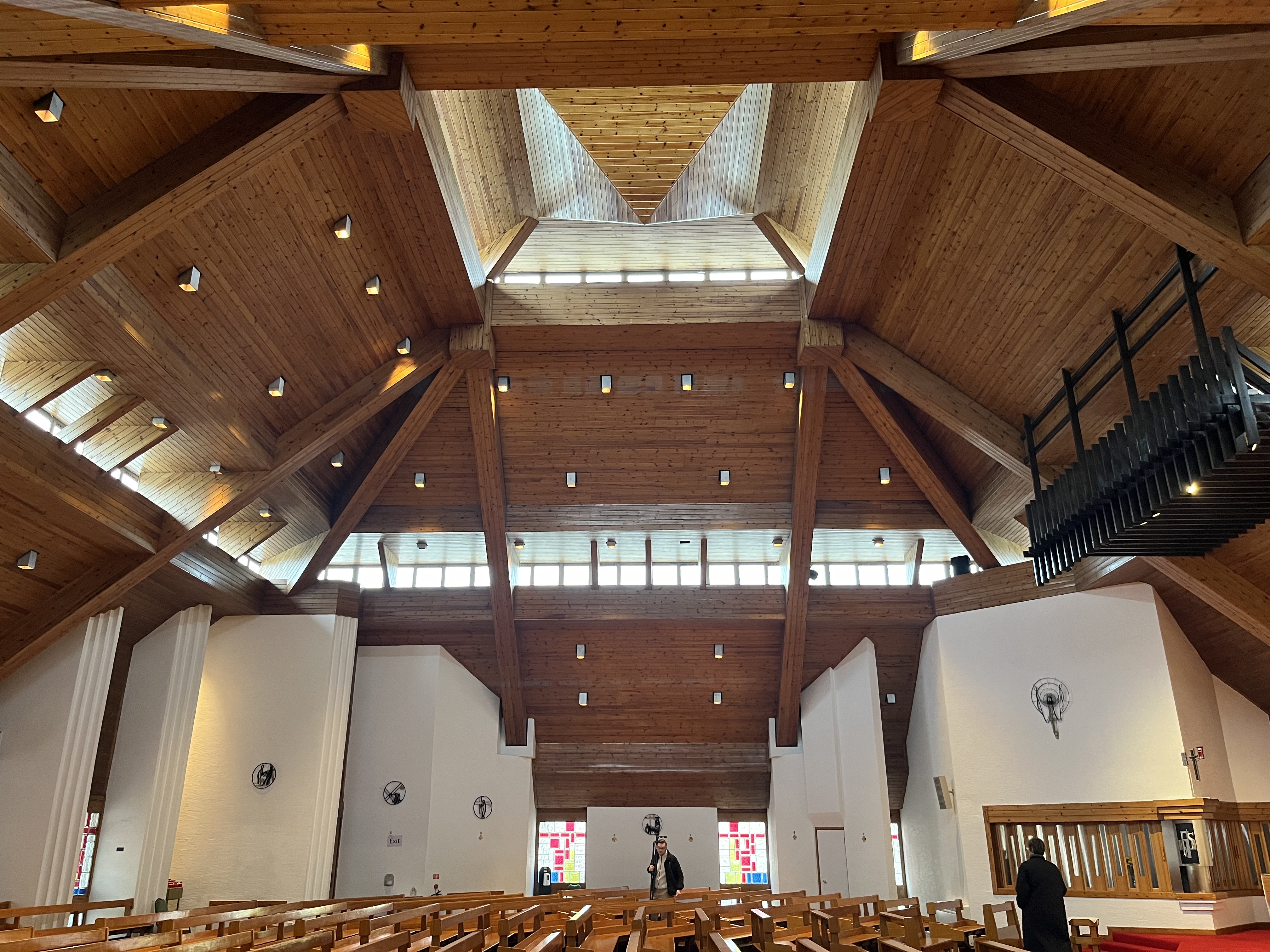 Interior (looking west) of St Bride’s RC Church © HES
How we designate listed buildings
We list buildings of special architectural or historic interest. A dedicated team researches and assesses all designation applications.
- Watch our video about how we list buildings
- Find out more about listed buildings in the Advice and Support section of the Historic Environment Scotland website.
- Read our Designation Policy and Selection Guidance (2019)
Why your views matter
We’d love to know whether you agree with our proposal.
To help you respond to the following survey, please read why we think St Bride’s RC Church meets the criteria for listing by downloading our Report of Handling.
You can tell us if you agree with our proposal by completing the short questionnaire below.
This questionnaire usually takes 5-10 minutes to complete.
Find out what comments we consider and what happens next in our consultation guide or watch our designations video on YouTube.
You can also watch a version of this video in British Sign Language.
What happens next
Please note that this consultation is now closed.
We are now considering the comments received at consultation before making a decision on designation. When we have reached a decision, we will publish this on our Portal, and it will also be available to view on Citizen Space.
Share
Share on Twitter Share on Facebook